精选文章Featured Articles
TapeOut 生态里值得通读的长文与教程,从最基础的逻辑门讲到链上流片与挖矿,按发布时间倒序。 Long reads and tutorials from around the TapeOut ecosystem — from basic logic gates to on-chain tapeout and mining, newest first.
24
篇精选articles
点击卡片在新窗口打开原文;封面与版权归原作者所有。 Cards open the original in a new tab; covers and rights belong to their authors.
 见解Insight从 ICO 到 ITO:TapeOut 的 ITO 正在打开新的机会From ICO to ITO: the issuance paradigm TapeOut is opening up复盘 ICO、IEO、IDO 三代发行的得失:门槛、信用与流动性都补上了,始终没补的是「交付什么」。文章认为 TapeOut 的 ITO(Initial Tape-Out)把可运行、可验证的电路容器本身当作交付物,并逐条分析参与门槛、叙事、早期效应与跨链入口四个条件。A review of ICO, IEO and IDO — each fixed the previous round’s weakness (access, credibility, liquidity) but none fixed what gets delivered. The case for TapeOut’s ITO (Initial Tape-Out): a running, verifiable circuit container is the deliverable, weighed against four conditions for a new issuance wave — low barrier, a short narrative, early believers, cross-chain reach.
 见解Insight当跨链的资产,是一台矿机When the cross-chain asset is a miner that keeps producing设想矿机与收益如何跨链:锁定映射 BEM、分离赎回权与收益权、分开核算资产覆盖率,再谈 1H 碎片、算力租赁与期限收益拆分,以及 DeWeb 能承担的可验证入口。How miners and their yield could move cross-chain: locking-and-mapping BEM, splitting redemption from yield rights, separate coverage accounting, then 1H fragments, hashrate rental, maturity-based yield splitting, and DeWeb as a verifiable entry point.
 教程Tutorial从 0 到 1:教你用 AI 在 TapeOut 里搭建一个永久网站From zero to one: build a permanent website on TapeOut with AI手把手教程:准备一个小钱包和任意能写代码的 AI,用提示词生成单文件 index.html,到容器工厂一键流片开容器,再经 Hashport 或 Tapeout Scan 上传。8.4MB 是单个文件的限制,超过可以分多次上传;全程 15–30 分钟,成本不到 100 元。A step-by-step walkthrough: prep a small wallet and any code-writing AI, prompt it into a single-file index.html, tape out once at the container factory, then upload through Hashport or Tapeout Scan. The 8.4 MB cap applies per file, so repeated uploads get around it. Fifteen to thirty minutes, under roughly ¥100.
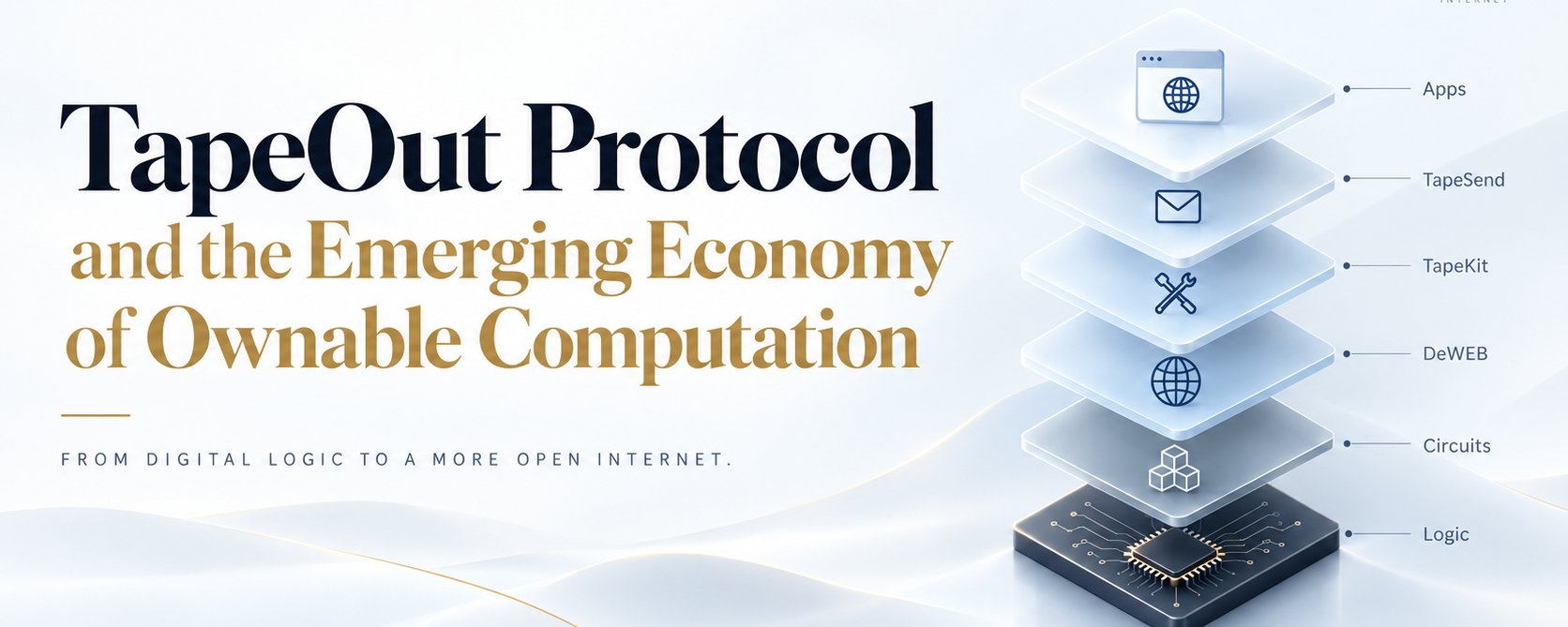 教程TutorialTapeOut 协议与「可拥有计算」的新经济:从 NAND、LATCH 到 DeWEB、TapeSendTapeOut Protocol and the Emerging Economy of Ownable Computation一篇把术语讲通的长文:NAND / LATCH 是元件,按 netlist 连好再流片就是电路,REF 让电路引用已完成电路而不必重造;容器(ERC-6551)给电路配账户,DeWEB 用 SiteRegistry 把网站绑到同一身份上——哈希只是文件指纹,能证明取到的是发布的那一份,不保证内容为真;TapeKit 取回并核对(要求两个独立 RPC 在同高度返回同样数据),HashPort 负责发布,TapeSend 把这个身份变成收件箱,端到端加密保护正文,但谁在何时发给谁、长度多少,链上仍可见。落点:不懂电路的普通人打开一个 TapeOut 应用,觉得「这东西有用」。A long read that makes the vocabulary click: NAND and LATCH are parts, wiring them per a netlist and taping out yields a Circuit, and REF lets a Circuit reuse finished Circuits instead of rebuilding them. A Container (ERC-6551) gives a Circuit an account, and DeWEB ties a website to that same identity through SiteRegistry — a hash is only a file fingerprint, proving you fetched the published copy, not that its claims are true. TapeKit retrieves and checks (two independent RPCs must agree at the same block height), HashPort publishes, and TapeSend turns the identity into an inbox: end-to-end encryption covers the body, while who messaged whom, when and how long stays visible on-chain. The closing note: an ordinary person who knows no circuits opens a TapeOut app and thinks, “this is actually useful.”
 见解Insight能被流片的不是 AI,而是决策面:TapeOut × Jev 系列研究 ver 1What can be taped out is not AI, but the decision surface — TapeOut × Jev, ver 1研究提案,非协议更新:值得固化的不是 AI 本体,而是收缩后的决策面——输入输出有限、状态明确、权限受限、默认拒绝。Jev 的 Choice / Score / Noul 只把模型输出收进窄接口,解决的是编码歧义而非世界真相;confidence、calibration、authorization 三件事不能互相顶替。两条连接路线:在线只让 Jev 提案,Circuit 与执行器独立限权;离线先冻结模型版本与输入合同,再讨论把有限策略做成可复核工件。文中也承认把世界编码成 bits 只是把模糊性藏到电路之外。A research proposal, not a protocol update: what deserves to be frozen is not the AI itself but a narrowed decision surface — bounded inputs and outputs, explicit state, restricted authority, deny by default. Jev’s Choice / Score / Noul only squeeze model output into a narrow interface, fixing encoding ambiguity rather than world truth, and confidence, calibration and authorization cannot substitute for one another. Two routes: online, Jev proposes while the circuit and executor hold authority independently; offline, freeze the model version and input contract first, then ask whether a bounded policy can become an auditable artifact. It also concedes that encoding the world into bits only moves ambiguity outside the circuit.
 教程TutorialTAPQQ 新手入门:从 0 到发出第一条链上消息TAPQQ for beginners: from zero to your first on-chain message先分清三个角色再动手:电路是基础资产,容器 / 端点才是「聊天账号」(形如 8.888、#4246@0),钱包只负责证明归属与付 Gas——最常见的错误就是把 0x 地址当账号填。之后五步走完:买电路或画布流片 → 开容器 → 到 HashPort 激活 → 登录 TAPQQ → 发出第一条消息。文末也直说门槛高、每步都要 Gas、UI 还粗糙。Sort out three roles first: a circuit is the underlying asset, a container / endpoint is the actual “chat account” (formats like 8.888 or #4246@0), and the wallet only proves ownership and pays gas — the classic mistake is typing a 0x address as the account. Then five steps: buy or tape out a circuit → open a container → activate it on HashPort → log into TAPQQ → send the first message. It ends plainly: high barrier, gas at every step, rough UI.
 见解InsightTapeKit:不只是一个新工具,而是互联网底层的一次重新设计TapeKit is not just a new tool — it is a redesign of the internet作者认为 TapeKit 比 TapeHub 更具颠覆性,逐层拆开它的分量:封杀一个网站的成本从封一个 IP 变成封掉整条公链;网站第一次真正属于持有私钥的人;上网的安全基础从信任机构变成逐字节核对哈希;网站变成可交易、可融资、可分红的生产资料;互联网从封闭花园回到开放积木场;数字出版第一次可能永久保存;TapeOut 从链上硬件扩到链上互联网基础设施;信息发布权再平权一次。结尾也承认存储成本、读取速度与体验都还很早期。TapeKit is more disruptive than TapeHub, the author argues, and unpacks it layer by layer: blocking a site now costs a whole chain instead of an IP; a site finally belongs to whoever holds the private key; security rests on byte-by-byte hash checks rather than trusted institutions; websites become tradeable, financeable, cash-flowing assets; the web turns from walled gardens back into open building blocks; digital publishing can be permanent for the first time; TapeOut widens from on-chain hardware to on-chain internet infrastructure; and publishing power is levelled once more. It closes by conceding that storage cost, read speed and UX are all still early.
 见解InsightBEM 挖矿逻辑是什么样的?与 BTC 的挖矿逻辑到底有什么区别?How does BEM mining work — and how is it different from BTC?BTC 是 PoW:任务统一、难度是协议全局参数、每 2016 个区块调整一次、四年减半,成本是硬件加电费。BEM 是 PoD(设计证明):买晶体管、在画布上做设计、流片销毁晶体管并铸成电路 NFT,全网打分排名后 Claim BEM。核心差异是这里没有全局难度参数——难度由玩家水平内卷自然抬升,复制别人的电路收益还会衰减。BTC is PoW: one shared task, difficulty as a global protocol parameter retargeted every 2,016 blocks, halving every four years, cost measured in hardware plus power. BEM runs on PoD — proof of design: buy transistors, design on a canvas, tape out to burn the parts and mint a circuit NFT, then claim BEM by ranked score. The key difference is that there is no global difficulty parameter here — difficulty rises organically as players get better, and copying someone else’s circuit pays less.
 见解Insight当 CZ 想要一只「永生果蝇」,为什么我想到的是 TapeOutCZ asked for an immortal fruit fly — why that points at TapeOut从 CZ 想要一只「永生果蝇」说起:数字生命的延续需要三件事——别人知道它是谁、能恢复它经历之后的状态、还能继续运行决定它行为的规则。作者逐项对照 TapeOut 的电路、REF 引用、容器与只读求值,并严格区分哪些已是协议能力、哪些仍需应用层自己实现。Starting from CZ’s call for an “immortal fruit fly”: lasting digital life needs three things — others know who it is, its state after experience can be restored, and the rules that drive its behaviour can still run. The piece walks through TapeOut’s circuits, REF composition, containers and read-only evaluation, marking what the protocol already does and what still needs application-level work.
 见解Insight注意力、供给与公共机器工作:一次个人思想实验A personal thought experiment on attention, supply, and public machine work个人研究笔记,非协议更新。Launchpad 给 BEM 添了一只快时钟——发现、社区与流动性;但注意力一天就能带来,之后仍得挣到被使用的理由。作者用三张图与四个可独立变化的账本(制造、使用、结算、市场质量)追问:注意力要变成什么,才算比一张 K 线更持久。A personal research note, not a protocol update. A Launchpad adds a fast clock for BEM — discovery, community, liquidity — but attention arrives in a day, and a reason to be used still has to be earned. Three exhibits and four independently moving ledgers (manufacturing, use, settlement, market quality) ask what would make attention more durable than a chart.
 见解Insight当果蝇反射变成电路:一个陌生人也能检查、质疑、改进的公共机器How a fly-inspired reflex became a Circuit strangers can inspect and challenge开放研究序列第三篇:把果蝇的躲避反射编译成硬布尔逻辑——策略 74 个 NAND、深度 11,有状态核心 173 个 NAND + 6 个 LATCH,在 65536 行输入与 838 万次状态转移上逐条验证。文中反复强调这不是果蝇大脑、不宣称生物学正确,重点是把行为写成一份陌生人可复现、可反驳、可做出更低成本版本的公开契约。Part three of an open research sequence: a Drosophila looming-escape reflex compiled into hard Boolean logic — 74 NAND gates at depth 11 for the policy, 173 NAND and 6 LATCHes for the stateful core, checked row by row across 65,536 inputs and 8.3 million transitions. Explicitly not a fly brain and no claim of biological validity; the point is a public behaviour contract strangers can reproduce, reject or reimplement more cheaply.
 见解Insight如果 TapeOut 真的成功,会创造怎样的新世界?If TapeOut actually works, what kind of new world does it create?「三代区块链」的框架:2009 年中本聪用比特币回答了价值如何原生存在于互联网,2015 年以太坊回答了程序如何原生存在于区块链,而 TapeOut 在试探第三个问题——数字硬件、计算逻辑与生产资料,能不能也原生上链。A three-generation frame: Bitcoin answered how value can live natively on the internet; Ethereum answered how programs can. TapeOut probes the third question — whether digital hardware, computing logic and the means of production can live on-chain too.
 教程TutorialTapeOut 入门指南:读懂 NAND、LATCH、电路与 $BEMTapeOut Explained: A Beginner’s Guide to NAND, LATCH, Circuits and $BEM很久没把关于创新的想法写下来了。越深入 TapeOut,越能体会它背后那个问题:如果把区块链当硅片用,人们能造出什么?从 NAND、LATCH 与电路讲到 PoD 挖矿、$BEM 和容器,再到链上计算这个更大的命题。From NAND, LATCH and circuits to PoD mining, $BEM and containers — and the bigger idea of on-chain computing. A beginner-friendly tour of what TapeOut is really asking.
 见解Insight当经验可以被烧成电路|逻辑门神经网络与 TapeOut 的下一条路When experience can be burned into a circuit: logic-gate neural netsAI 行业一直在做加法:更多参数、更长上下文、更多 GPU、更大的数据中心,我们也越来越习惯用规模解释智能。这篇走反方向——把经验烧成逻辑门电路,谈逻辑门神经网络与 TapeOut 的下一条路。AI has spent years adding — more parameters, longer context, more GPUs, bigger data centers — until we explain intelligence by scale. This essay takes the other direction: burning experience into logic-gate circuits.
 教程TutorialTapeOut 部署、购买与挖矿教程TapeOut: deploying, buying parts and mining参与 TapeOut 先分清两件事:创建 Processor 是创建提供元件的处理器,发布流片则是消耗元件、生成自己的电路 NFT。对已经做好电路设计的人,操作顺序是买元件 → 发布流片 → 开挖。Two things to keep apart when starting out: creating a Processor provides the parts, while taping out consumes them and mints your own circuit NFT. If your design is ready, the order is buy parts → tape out → start mining.
 见解Insight当所有人都把计算搬离主网,TapeOut 却把 Linux 塞了回来Everyone is moving compute off-chain. TapeOut put Linux back on.这不是云计算,也不是更快的虚拟机,而是一场关于「计算过程能否成为公共事实」的反向实验:当 Rollup 们争相把昂贵计算搬离主网,TapeOut 反而把整个 Linux 内核塞回 L1 执行。Not cloud computing, not a faster VM — a reverse experiment in whether a computation can become a public fact. As rollups race to move costly work off Layer 1, TapeOut puts a whole Linux kernel back onto it.
 教程TutorialTapeOut 协议 $BEM 初阶挖矿教程TapeOut $BEM: a beginner’s mining tutorial不了解 TapeOut 的逻辑原理问题也不大,先学会参与、先上车再慢慢研究也可行。面向初学者整理的入门教程,基础背景可以看同系列的上一篇。Not understanding the logic first is fine — signing up and learning as you go works too. A beginner-oriented walkthrough of mining; read the earlier explainer in the same series for the background.
 教程TutorialTapeOut 小白入门挖矿教程|4 步教会你如何挖 BEMTapeOut mining for beginners: four steps to BEM挖 BEM 到底怎么开始?作者把整套流程跑通了,就 4 步:选对交易对 → 用 BNB 买 NAND → 生成电路并流片 → 去工作台点启动,并附上官方主站与第三方工具的入口。How do you actually start mining BEM? Four steps, end to end: pick the right pair, buy NAND with BNB, build and tape out a circuit, then hit start in the workbench — with links to the official site and third-party tools.
 教程TutorialTapeOut Protocol 小白科普:从与非门到链上挖矿,一次真正读懂这个项目TapeOut Protocol explained: from NAND gates to on-chain mining市面上的教程大多直接跳到「怎么流片、怎么挖矿」,把最基础的逻辑门、晶体管、电路一笔带过,读起来总像隔着一层。这篇从与非门讲起。Most guides jump straight to how to tape out and how to mine, glossing over the logic gates, transistors and circuits underneath. This one starts from the NAND gate.
 教程TutorialTapeOut 保姆级解读:16 岁少年做的链上 CPU 是什么?普通人怎么参与?A plain-language TapeOut explainer: what is this teen-built on-chain CPU?一句话说清楚:TapeOut 是把 Token 当晶体管用的链上电路设计协议。从 8 月 15 日 Blonskr 宣布在 BNB Chain 上跑起 CPU 讲起,再拆开普通人怎么参与、各环节的收益来自哪里。In one line: TapeOut is a protocol that treats tokens as transistors. Starting from the CPU announced on BNB Chain on 15 August, it walks through how an ordinary person can take part and where the returns come from.
 见解Insight当机器开始在链上进化:TapeOut 与一座公共机器文明的诞生When machines start evolving on-chain: TapeOut and a public machine civilizationPoD 最终挖的也许不是币,而是人类与 AI 把同一个问题做得更好的能力。公共机器文明不是一枚 Token 的放大图,而是从最小逻辑单元开始、由无数次可验证设计共同构成的基础设施。What PoD ultimately mines may not be a coin, but the ability of humans and AI to do the same problem better. A public machine civilization is not a token writ large — it is infrastructure assembled from the smallest logic units up.
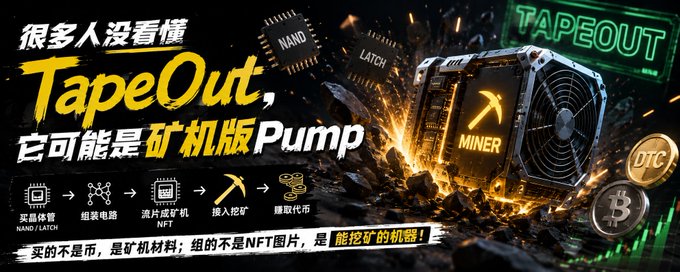 见解Insight很多人没看懂 TapeOut:它可能是一个「矿机版 Pump」Most people are missing TapeOut: it may be a miner-shaped PumpNAND、LATCH 到底有什么用?流片成电路 NFT 之后呢?买完晶体管除了等别人接盘还能干什么?这篇从「看不懂」讲起,给出一个视角:TapeOut 可能是一个矿机版的 Pump。What are NAND and LATCH actually for? What happens after you tape out a circuit NFT? And beyond waiting for a buyer, what do the parts do? Starting from that confusion, this piece offers one lens: a miner-shaped Pump.
 教程Tutorial从 Mint 到流片:TapeOut 新手第一次上手指南From minting to tapeout: a first-timer’s TapeOut walkthrough新手别急着看价格和哪个「芯片」值得 Mint,先看它能不能做事,再决定要不要持有它的元件。拆开讲 Mint 元件、订单簿挂单、授权与流片的每一步,并附风险提示:链上操作都可能不可逆。Don’t start with prices or which chip looks worth minting — see what it can do first, then decide whether to own its parts. Covers minting parts, the order book, approvals and taping out, with a reminder that every on-chain step can be irreversible.
 教程TutorialTapeOut 怎么玩,以及它到底值不值得看How TapeOut works, and whether it is worth your time先说结论:TapeOut 不是「在 BSC 上造出一颗真实芯片」这么简单粗暴的故事,更像把逻辑门做成链上资产,让你拿这些资产在链上拼电路、流片、生成可调用的电路 NFT。有噱头,也确实有点东西。The short version: TapeOut is not simply “building a real chip on BSC”. It is turning logic gates into on-chain assets you assemble into circuits, tape out and mint into callable circuit NFTs. Hyped — and genuinely interesting.