TapeOut Protocol and the Emerging Economy of Ownable Computation
A long read that makes the vocabulary click: NAND and LATCH are parts, wiring them per a netlist and taping out yields …
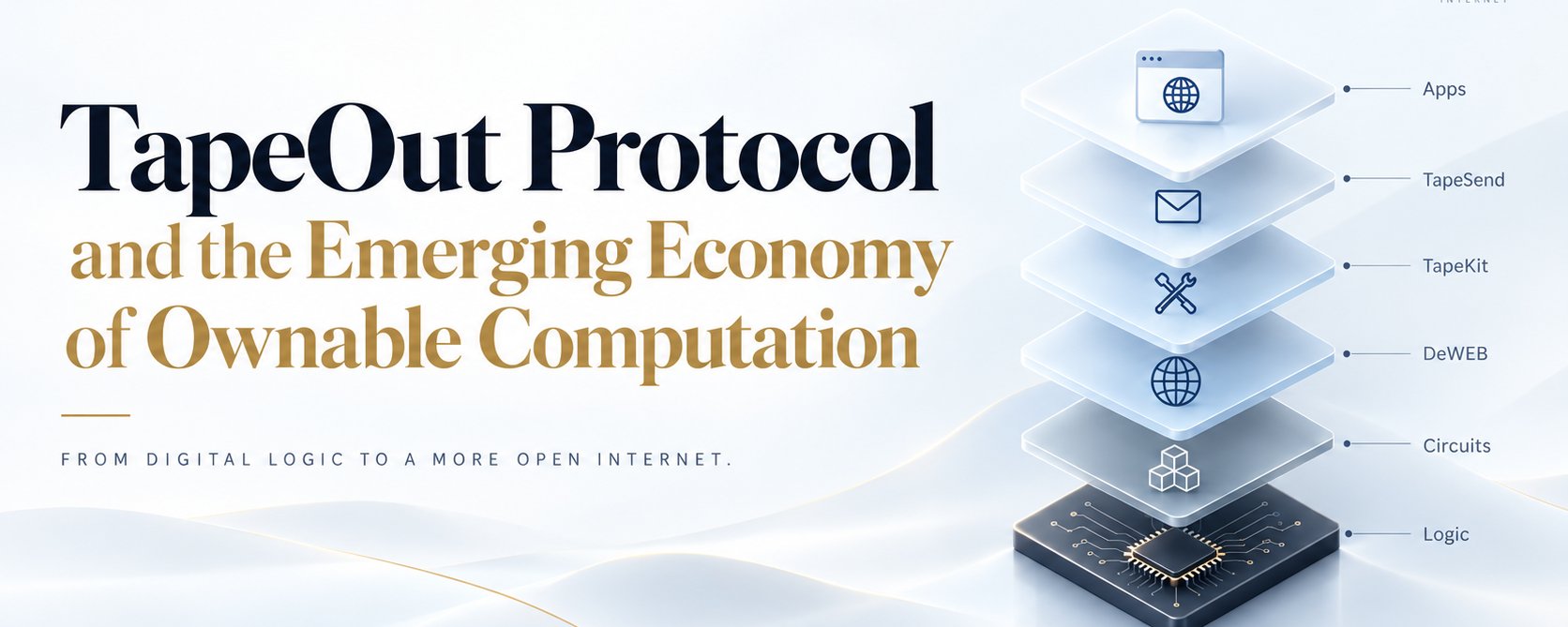
When you first come across TapeOut protocol created by @Blonskr, it is easy to get lost in unfamiliar names: NAND, LATCH, Circuit, Container, DeWEB, and more.! You do not need to memorize them all at once. Start by thinking of TapeOut as a set of computing building blocks on a blockchain. Some handle calculations. Others remember information. Connect them according to a design, and they can perform different functions. Once someone has built a useful function, other people can use it too.
Many people discover TapeOut through mining. Buying components, assembling miners, checking their output, and earning $BEM through the Proof of Design mining system are familiar ways to participate. Look a little further, though, and mining becomes one part of a larger picture. A Circuit can have an associated account. A website can be connected to that account, and messages can be sent to the same identity. The ecosystem’s Linux demonstration goes further, exploring how a more complete computing environment can be organized.
For me, the most interesting question is: when these capabilities begin to connect, what can people actually make with them? Some may arrive to mine. Others may simply want to create a small game, publish a website, or build a tool for their community. The TapeOut I look forward to is a place where all these different ideas can find a practical starting point.
1. Start With the Pieces
Suppose you want to build a simple counter. Each time you press a button, the number goes up by one. It needs to do two things: remember the current number and calculate the next one. That sounds simple, but the relationship between calculation and memory is a useful starting point for understanding circuits.
TapeOut’s two foundational components are NAND and LATCH. NAND follows a fixed rule for two inputs, each either 0 or 1: it returns 0 only when both inputs are 1, and returns 1 otherwise. You do not need to become fluent in this rule immediately. For now, think of it as a basic logical operation that can be combined with others. LATCH is more like a tiny notepad. It can store a single 0 or 1 so that a later calculation can use information from an earlier step. These are virtual components represented through contracts, not physical chips being manufactured inside a blockchain.
Connect these components according to a design, and you get a Circuit. It receives inputs, processes them according to its rules, and produces outputs. Some Circuits also use memory. The description of how the components connect is called a netlist, which you can think of as a wiring diagram. A Processor can be understood as an independent circuit ecosystem within TapeOut. Each Processor onchain has its own dedicated Circuit NFT contract and maintains a separate namespace for Circuit IDs.
A developer can design and test a Circuit before publishing it. When they are ready, they can “tape out” the design. In TapeOut, this does not mean sending it to a physical chip factory. It means submitting a transaction that burns the required component tokens and represents the completed design as a Circuit NFT. In practical terms, the parts have become a finished object with a defined design and a recorded owner. Technically, the components use the ERC-1155 standard and Circuit NFTs use ERC-721. For a newcomer, understanding the difference between the parts and the finished object is enough to begin.
However, building a Circuit and running it are two different things. A read-only call can show what result a particular input would produce. Recording a change in state on the blockchain requires an appropriate transaction. The Circuit supplies the rule; a user or another program calls it. It does not keep working in the background simply because someone owns it.
Once that distinction is clear, the rest becomes easier to follow. TapeOut provides components that can be assembled into different functions. Application developers decide when to use those functions and which problems they should solve.
2. You Do Not Have to Start From Scratch
Building every new application from the smallest possible components would be a lot of work. A more useful arrangement is one where people can use functions that others have already completed, leaving more time for the parts they genuinely want to create.
TapeOut’s REF mechanism lets one Circuit reference another completed Circuit, including one created under a different Processor. Suppose your design needs a calculation that an existing module already performs. You can incorporate a suitable module instead of rebuilding every logic gate inside it.
Imagine how this might work. One person creates a module that counts how many switches are on. Another person is developing a game and needs that exact function, so they use it in the game’s rules. A third person adds more components to those rules and creates a larger simulation. The original developer may never have imagined the final application, yet their work can still contribute to it. This is an example of how reuse could work, rather than a description of one particular finished product.
That is what I find most appealing about computing building blocks: a small function you build carefully today can become someone else’s starting point tomorrow. Nobody has to do everything. One person may be good at the underlying logic, another at product design, and another at creating a clear interface. Their contributions have a way to come together.
An ecosystem can become richer through that process. Instead of depending entirely on one person to keep releasing new things, it can use the work that already exists to help more people create whatever comes next.
3. Containers and DeWEB: An Account for the Circuit, an Identity for the Website
So far, we have mainly discussed functions: what a Circuit can calculate and how another developer can use it. A real application also needs to handle other questions. Where do its associated assets sit? Who can manage them? Which page does a user open to access the service?
A Container can be understood as an account associated with a Circuit(ERC-6551). It is a smart contract account that can hold assets and perform permitted operations according to its rules. Control is linked to the Circuit’s holder. The Circuit provides computational logic, while the Container provides an associated account. They have different roles, and having an account does not make the Circuit capable of deciding what to do on its own.
This brings us to DeWEB. For most people, an application begins with a page they can open, not a collection of contract addresses. DeWEB explores publishing website files onchain and associating them with a Circuit Container. A contract called SiteRegistry organizes those files and records information such as their paths, types, sizes, and hashes. Compatible software can retrieve the files and check them against those records.
“Hash” sounds technical, but you can think of it as a digital fingerprint for a file. After retrieving a file, the software calculates its fingerprint and compares it with the one recorded when the file was published. A match helps establish that it received the corresponding file rather than a different version with altered contents. This checks whether the file matches the record. It does not guarantee that every statement on the website is true or that every action it offers is safe.
The significance goes beyond storing a website in a different place. It also creates a clearer relationship between a website, its associated account, and the person authorized to manage that account. The page users see can be connected to the ownership structure behind the application.
A simple way to remember this part is: the Circuit provides a function, the Container provides an account, and DeWEB allows a website to be associated with that account.
4. TapeKit and HashPort: One Helps You Open a Website, the Other Helps You Publish It
However interesting the technology may be, people still need a practical way to use it. A website owner needs to know how to publish, while a visitor needs a way to open the site and check what they receive. TapeKit and HashPort help with those two sides of the process.
TapeKit provides tools for reading and checking content. Given a supported website identity or address, it finds the associated files, retrieves them, and checks them against the onchain records. It requires RPC nodes from two independent operators to return the same data at the same block height. If their results do not match, the request is rejected outright. The point is not simply to open a page. It is also to establish that the files being opened match the publication records associated with the intended identity.
HashPort mainly helps website owners publish their content. A developer selects a suitable Circuit with a Container, uploads a prepared website folder, and uses the service to help manage the required publication transactions. It also supports optional binding to a conventional domain name. Put simply, HashPort helps you publish the website; TapeKit helps other people retrieve and verify it.
At the time covered by this article, HashPort advertised no publishing service fee. Platform service fees and blockchain transaction fees are separate, however. Users still need to account for applicable gas costs, with the actual terms shown by the interface and transaction request at the time of use.
For me, the value of tools like these is practical. Someone who wants to make a website should be able to spend more time on its content, features, and usability instead of repeatedly dealing with storage details. The easier the publishing process is to understand, the easier it becomes to build something small and discover whether anyone actually needs it.
When someone can move from a prepared website folder on their computer to a site their friends can open, an abstract technical idea starts becoming a usable tool.
5. TapeSend: An Inbox for the Same Identity
A website lets you explain what a service does. But people may also want to contact you, report a problem, or send a message. TapeSend builds on the Circuit Container model to provide that communication channel.
In TapeSend, a Container can serve as a messaging address. Its holder sends messages using that identity under the system’s rules. A contract called the DeWEB Hub records inbox and outbox information. The receiving software uses message fingerprints to check that the encrypted content it retrieves matches the recorded message. The same Circuit identity can therefore be associated with an account, a website, and a way to communicate.
Imagine building a small game. Its website explains how to play, its associated account holds designated assets, and its messaging address lets players contact the operator. These are still separate functions, but they can be organized around the same Circuit identity rather than represented by unrelated usernames and accounts. This describes a possible application design.
TapeSend’s documentation describes end-to-end encryption for message content, including supported small image attachments. But encrypted content does not mean that every detail of the communication is hidden. Who communicates with whom, when a message is sent, and its length remain visible onchain. Think of the contents of a letter being protected while some information on the envelope remains public.
Asset attachments work differently. They correspond to real transfers into the recipient’s Container, and the receiving software checks the relevant onchain records. Tokens are not placed “inside” the message. Instead, the message is associated with a transfer that actually occurred.
The promising part is that other developers can use the same underlying communication system to create different products. One might build a support tool, another a community chat interface, and another a collaboration or notification service. They do not all need to look or feel the same to benefit from a shared identity and messaging model.
6. What Happens When These Pieces Work Together?
Looking back at the names now, they are no longer just a collection of unrelated technical terms. A Circuit is a functional module. REF allows modules to be reused. A Container provides an associated account. DeWEB connects a website to that identity. HashPort helps publish it, TapeKit helps retrieve and check it, and TapeSend provides communication.
Imagine a future application that combines these capabilities. A user opens its website, and compatible software checks the page files. When the application needs to apply a particular rule, it calls a Circuit that may itself use a module created by another developer. A Container holds relevant assets and provides an account for permitted operations. When users need help, they can contact the service through its associated messaging identity. Developers would still need to connect these capabilities properly to create a smooth, useful product.
More specific operations could include an additional permission check. A rule might first determine whether a request is allowed, then pass it to another program or contract for execution. “This may be done” and “this has been done” are different things. One is a decision; the other is an action. The application needs to connect the two correctly.
This is part of what I appreciate about @Blonskr and the community’s builders. Their work makes it possible to have increasingly concrete conversations about which component should handle a function, how different tools should work together, and what problems they could solve for ordinary users. There is more than a broad vision to discuss. There are things people can pick up and experiment with.
The moment I look forward to most is not when everyone can explain NAND, LATCH, and netlists. It is almost the opposite: someone who knows nothing about circuits opens a TapeOut application, understands what it can do for them, and thinks, “This is actually useful.”
They do not need to know who designed the underlying components or how many improvements the tools went through. They simply benefit from the result, while a small piece of work another developer carefully completed helps make that experience possible.
For me, the most exciting thing about TapeOut is that it does not feel like a protocol built around a single feature. It feels like the beginning of a new computational layer for crypto. NAND and LATCH are only the starting point. From there, TapeOut expands into reusable Circuits, programmable ownership, Containers, DeWEB, TapeKit, TapeSend, and increasingly richer application possibilities. Each new layer makes the original idea more powerful, because the protocol is not simply creating isolated products; it is creating a foundation that other builders can keep extending.