A personal thought experiment on attention, supply, and public machine work
A personal research note, not a protocol update. A Launchpad adds a fast clock for BEM — discovery, community, liquidit…

A personal thought experiment on attention, supply, and public machine work
This is a personal research note, not a protocol update. The three exhibits are simplified mechanism thought experiments, not price forecasts, valuation targets, probability estimates, trading advice, or a solicitation to buy, sell, or provide liquidity. I discuss Tapeout Launchpad only at the level of a public product direction; I am deliberately not making claims about its website, implementation, detailed rules, launch schedule, or anyone else’s parameters.
The question I have been thinking about
I have been trying to model a simple question about BEM.
What happens when a work asset gains a Launchpad: a faster way to organize attention around new projects?
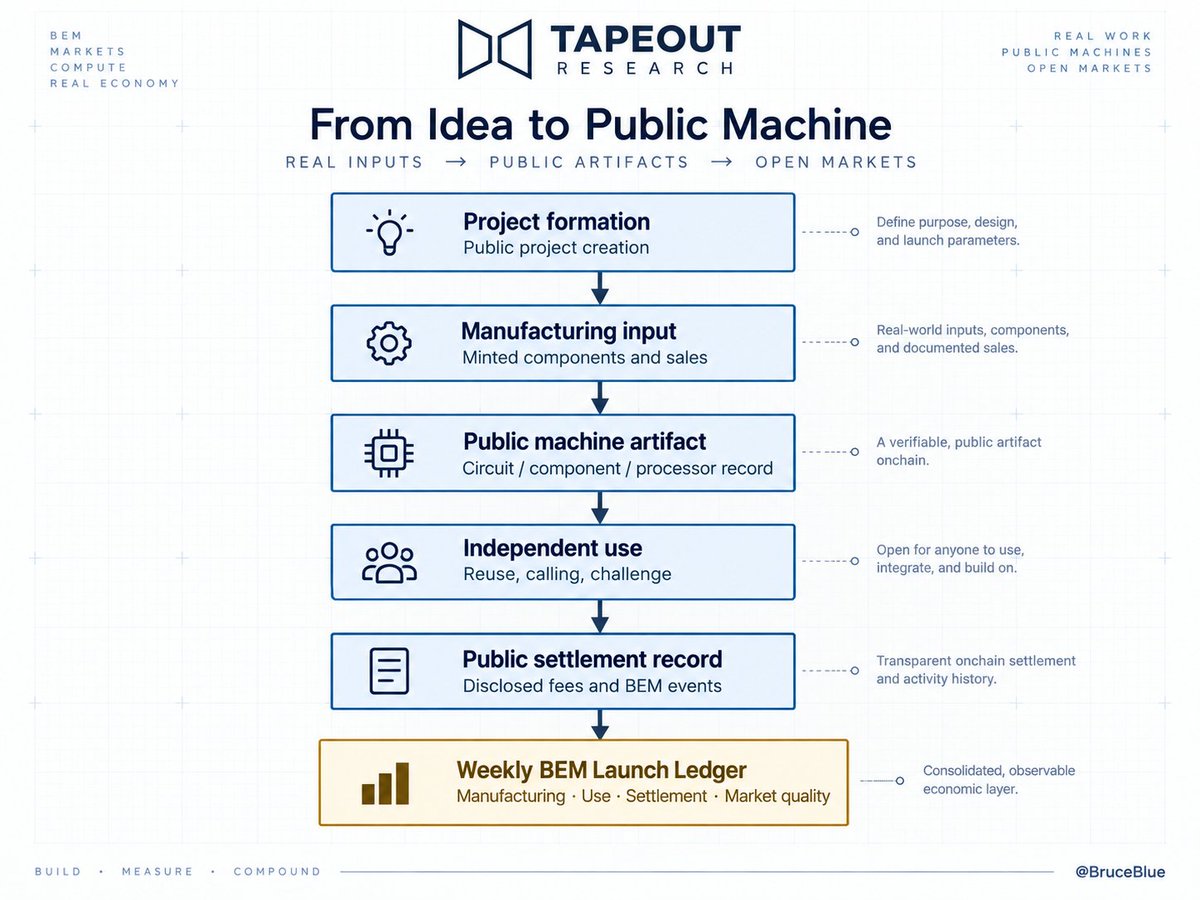
Before Tapeout Launchpad, the mental model of BEM was relatively slow. People make components. They assemble Circuits. They burn inputs to create an artifact. They try to improve a design. In the best case, another person reuses it. Value has to travel through work before it becomes visible.
Tapeout Launchpad adds a second clock. A new project can be discovered faster. A community can gather faster. Liquidity can appear faster. A long story about building may be compressed into a short market window.
That is not inherently bad. It is also not enough.
Tapeout Launchpad can bring attention in a day. BEM still has to earn a reason to be used after that day.
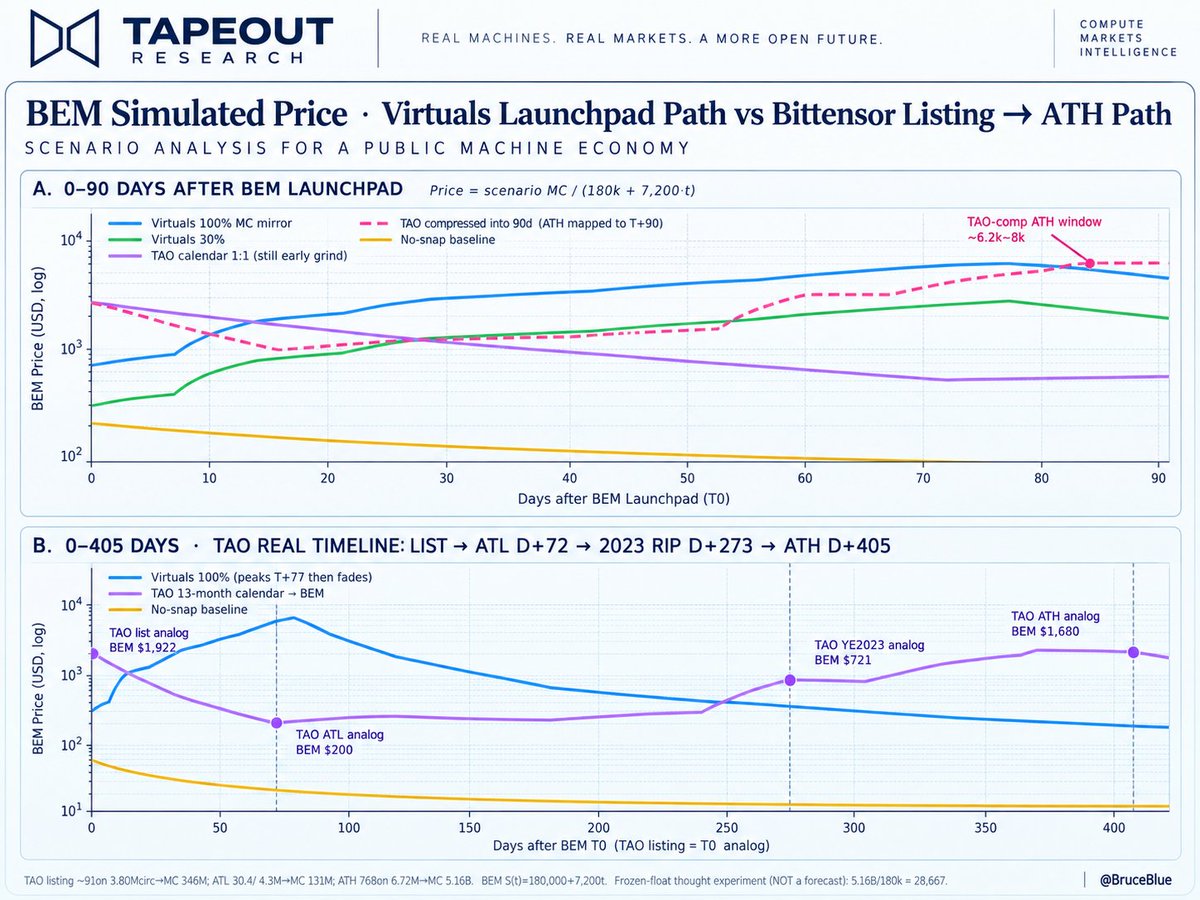
The charts below are my attempt to make the tension visible. They do not say where BEM will trade. They ask what would have to become true for attention to become something more durable than a chart.
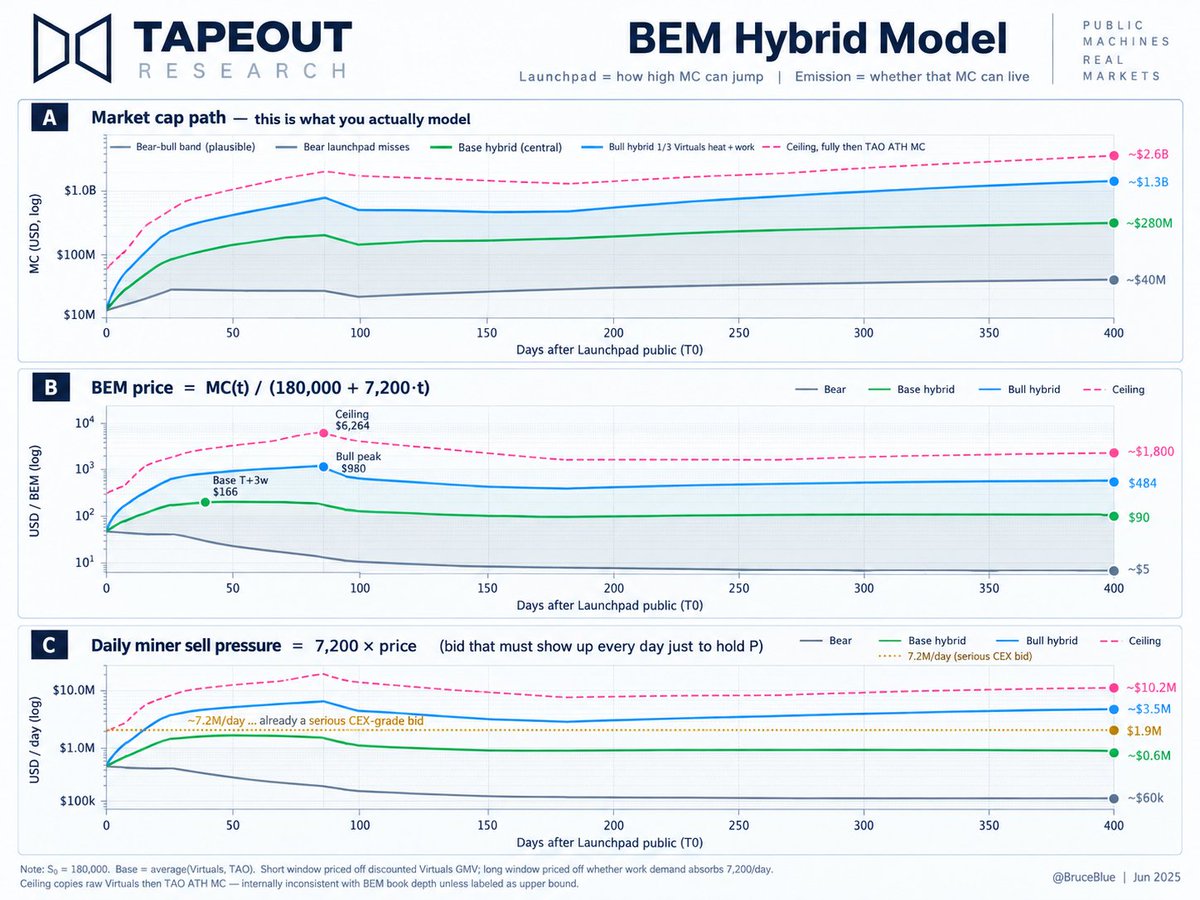
The first exhibit puts three ideas next to each other: an attention-driven market narrative, a per-unit supply path, and the incremental inventory that could seek a buyer if holders decide to sell.
People often collapse all three into one sentence: “the narrative is stronger, so the asset should be worth more.” But those are separate questions.
An attention event can change how many people are looking at BEM. It does not itself establish why people will need it later. Supply can expand without becoming immediate sell pressure. Sell pressure can exist without being visible in a single marginal quote. And a thin market can look more certain on a screen than it is in reality.
So I do not read Exhibit 1 as a price map. I read it as a settlement question:
If the story gets bigger, what recurring activity is strong enough to absorb the economic obligations the story creates?
TAO and Virtuals are useful as two clocks—not as two templates
I find TAO and Virtuals useful here, but only after stripping away the temptation to copy their curves.
TAO represents a slow work clock. Its economic story became legible through the long interaction of emission, network participation, validation, subnets, and public market discovery. The relevant lesson is not its later market capitalization. The lesson is that an emitting asset ultimately has to be understood through the work and security system that sits underneath it.
Virtuals represents a fast attention clock. Its launch mechanics made project formation, liquidity, distribution, and creator economics easy for the market to see. The relevant lesson is not that every asset should reproduce an agent-token launch model. The lesson is that good infrastructure can organize attention before a project has years of history.
It is a reminder that a BEM-like asset may have to live under both clocks at once. One clock is fast: discovery, community formation, liquidity, narrative compression. The other is slow: whether the asset becomes necessary for making, using, verifying, or settling public machine work.
TAO teaches a discipline: respect emission. Virtuals teaches a product lesson: infrastructure can organize attention. Neither tells us the answer for Tapeout.
The only conversion that matters
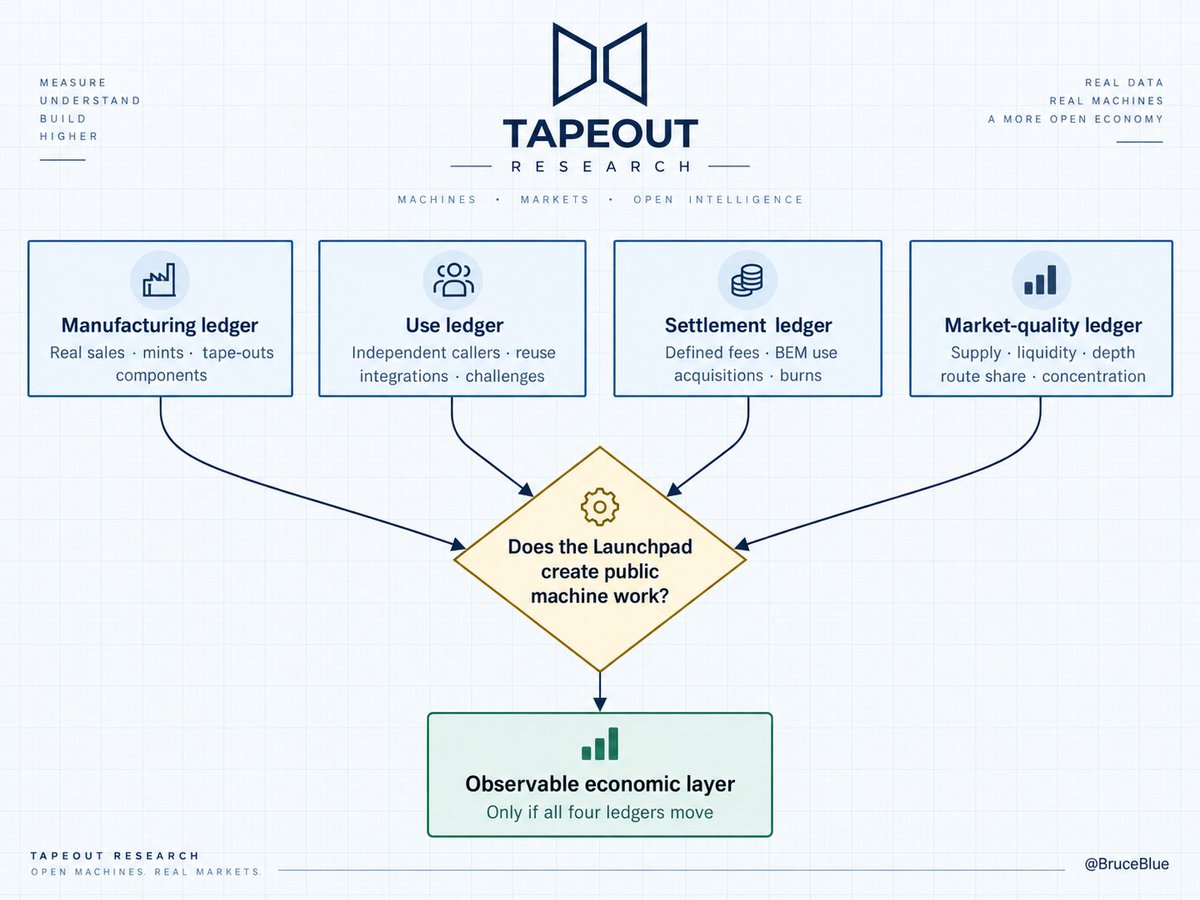
The third exhibit contains the part I care about most. I would not describe its curves as “100% mirror,” “30% realization,” or “the downside.” Those labels make the chart sound like a target board.
I would translate them into three conditions.
The upper sensitivity is attention retained: a world in which market attention remains unusually persistent. The lower sensitivity is attention without settlement conversion: people look, talk, trade, and move on. The middle sensitivity is the only scenario worth studying: a portion of initial attention is converted into recurring machine work, disclosed economic flows, and some visible reason for BEM to be acquired, used, or removed from active circulation.
This is not a claim that any of these outcomes will happen. It is a research lens for asking what evidence distinguishes one outcome from another.
The ledger test
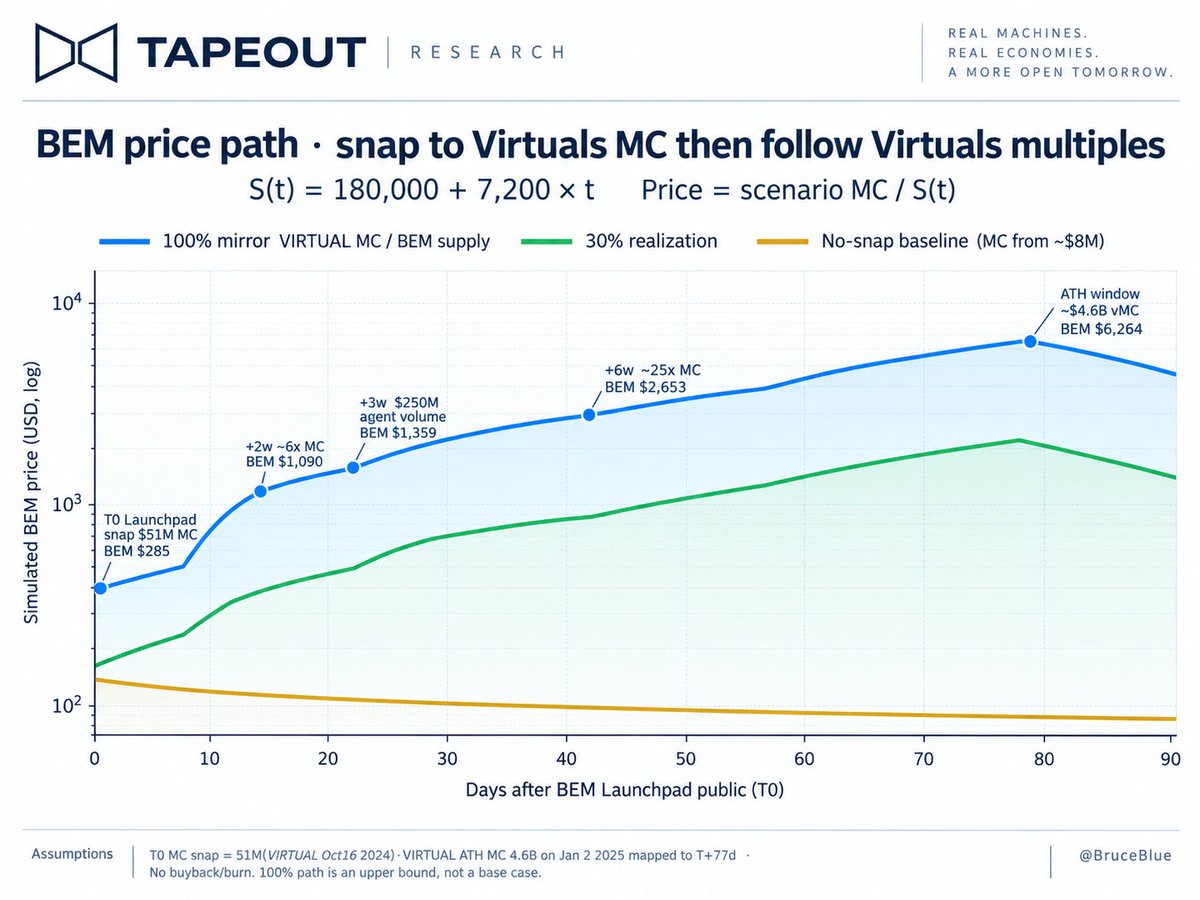
If I wanted to know whether the middle scenario was becoming more credible, I would not start with price.
I would ask for four ledgers that can move independently: a manufacturing ledger, a use ledger, a settlement ledger, and a market-quality ledger. A project appearing is not the same as a machine being made. A machine being made is not the same as another person using it. Use is not the same as settlement. And an acquisition or retirement event is not automatically a change in net available supply.
The point of a public ledger is not to manufacture a flywheel. It is to prevent five different events from being called the same thing. A fee, a liquidity-provider fee, an asset acquisition, an asset retirement, and an accounting balance are different events. The moment they are merged into one word—“buyback,” “revenue,” or “demand”—the public loses the ability to check what is actually happening.
Why Tapeout Launchpad makes this a Tapeout question
Tapeout Launchpad is interesting to me not because it might create more assets. Many systems can do that.
The interesting possibility is that a project can begin with attention but leave behind a public record of work: what was made, what inputs were consumed, what Circuit was produced, what was reused, what was challenged, and which economic claims can be reconciled against that history.
That is the only version of a “machine economy” I find worth pursuing. Not an economy where every new name automatically produces token demand. An economy where a project can begin with an artifact, and where more work produces more evidence rather than merely more slogans.
The Launchpad clock matters because it brings people to the door. The work clock matters because it decides whether there is a room behind it.
Closing
My conclusion is deliberately narrower than a market call.
I do not think BEM needs to become a smaller VIRTUAL. I do not think Tapeout Launchpad should be priced as a compressed TAO timeline. I do think there is an open question worth researching: whether Tapeout can turn short-lived Launchpad attention into recurring, inspectable machine work and a settlement trail that strangers can verify.
The strongest future BEM chart may not be a borrowed curve. It may be a public record showing, in the same period, what machines were made, who used them, what they settled, and how that activity related to new supply. #TapeOut #BNBChain
Research boundary
This note is a personal mechanism thought experiment. The exhibits use simplified, author-selected scenarios to make the relationship between Launchpad attention, supply, and settlement legible. They are not forecasts and do not describe a known or promised implementation. TAO and Virtuals are used only as high-level conceptual comparisons. Nothing here is investment advice, trading guidance, a price target, a return promise, or a solicitation of liquidity.
References
[1] Opentensor Foundation, TAO Token Economy Explained.
[2] Bittensor Docs, Emissions.
[3] Virtuals Protocol, Virtuals Launch Mechanics.