TapeOut 是什么What is TapeOut
一套区块链协议,用晶体管搭电路、把电路固化成链上资产,再让它承载网站与算力。A blockchain protocol to build circuits out of transistors, freeze them on-chain, and let them carry websites and compute.
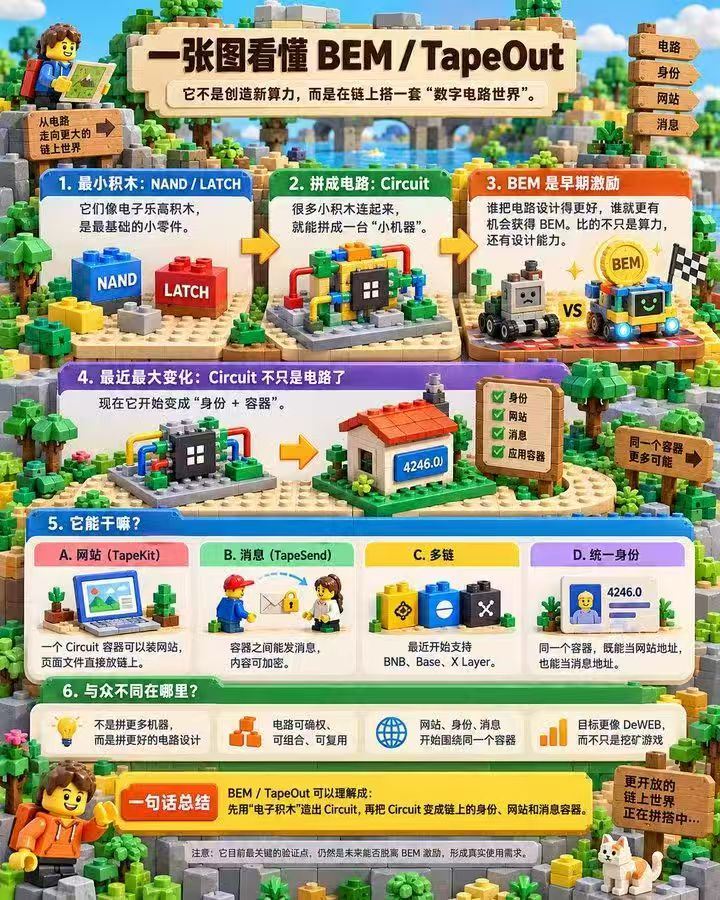
一句话
TapeOut 是运行在 BNB Chain 上的一套协议:把基础逻辑门做成代币,一个代币代表一种逻辑门(NAND 或 LATCH),协议把它们统称「晶体管」。任何人用这些代币在链上搭电路、造处理器,再把电路固化成链上资产,让它承载网站、算力甚至 AI。它想让区块链从「记账」走向「承载可验证的生产工具」。
为什么需要它
传统芯片的设计、流片与制造集中在少数厂商手里:设计文件私有、产线不可审计,普通人很难参与,更难验证。TapeOut 换了方向——把最小元件摆上链,谁都能设计、流片、运行,每一步公开可查。
名字从哪来:「流片」
「Tape-out(流片)」是半导体术语:芯片设计完成后交给晶圆厂制造,这一步叫流片。TapeOut 借用了这个词——在这里,流片指你在画布上设计好电路、点下按钮,用掉的晶体管被销毁,链上诞生一枚代表这个电路的 NFT。没有硅片,没有工厂,全是链上的数据与合约。
从元件到电路
- 晶体管:协议对逻辑门代币的统称,做成 ERC-1155;一个代币代表一种逻辑门。
- 与非门(NAND):负责「算」,所有逻辑都能用它搭出来。
- 锁存器(LATCH):负责「记」,保存 1 位状态。
- 组合逻辑:把两者拼成触发器、寄存器、加法器,就有了计算能力。
区块就是时钟
BNB Chain 约 0.45 秒出一个块,链上处理器就走一拍,约 2.22 Hz——宣言自嘲是「全宇宙最慢的 CPU」。区块持续出,电路就永远在线:任何人可免费、只读地调用它,不产生交易、不花钱。
流片、容器与 DeWEB
- 流片:把画好的设计提交上链,固化为电路 NFT,这一步消耗元件。
- 电路容器:基于 ERC-6551,给电路配一个自己的账户,可持有资产、发起交易。
- DeWEB:用 SiteRegistry 把网站绑定到容器,再经 HashPort 发布,站点就长在链上。
- 地址体系:电路是基础资产,容器与端点是账号,如
8.888、#4246@0;钱包只负责证明归属与付 Gas。
术语速查
| 术语 | 说明 |
|---|---|
| 流片 | 把电路设计固化为链上资产的过程 |
| 晶体管 | 最小元件,做成 ERC-1155 代币 |
| 电路 NFT | 流片产出的资产(ERC-721),可被容器持有与运行 |
| 容器 | ERC-6551 账户,挂在电路上 |
| DeWEB | 跑在链上的网站 |
| TapeKit | tape:// 协议与浏览器工具,双 RPC 核对哈希 |
In one line
TapeOut is a protocol on BNB Chain: it turns basic logic gates into tokens — one token stands for one logic gate (NAND or LATCH), which the protocol calls a "transistor". With these tokens anyone can build circuits and processors on-chain, freeze them into on-chain assets, and let them carry websites, compute, even AI. The goal is to push the blockchain from record-keeping toward verifiable production tools.
Why it matters
Traditional chip design and fabrication sit with a few vendors: design files are private, fabs are not auditable, and outsiders can neither take part nor verify. TapeOut flips this — put the smallest components on-chain, let anyone design, tape out and run, with every step publicly checkable.
Where the name comes from: "tape-out"
"Tape-out" is a semiconductor term: once a chip design is finished it goes to the fab for manufacturing, and that step is the tape-out. TapeOut borrows the word — here it means you finish a design on the canvas and press a button, the transistors you spend are burned, and an NFT representing that circuit is born on-chain. No silicon, no factory, all data and contracts on-chain.
From components to circuits
- Transistor: the protocol's umbrella name for logic-gate tokens, minted as ERC-1155; one token stands for one logic gate.
- NAND gate: handles "compute" — all logic can be built from it.
- LATCH: handles "memory" — holds one bit of state.
- Combinational logic: wire both into flip-flops, registers and adders, and you get computation.
The block is the clock
BNB Chain produces a block roughly every 0.45 seconds, advancing the on-chain processor one tick — about 2.22 Hz, which the manifesto jokes is "the slowest CPU in the universe". As long as blocks keep coming, circuits stay online: anyone can call them for free, read-only, with no transaction and no cost.
Tapeout, containers and DeWEB
- Tapeout: submit a finished design on-chain and freeze it into a circuit NFT; this step consumes components.
- Circuit container: an ERC-6551 account attached to a circuit, able to hold assets and send transactions.
- DeWEB: bind a website to a container via SiteRegistry, publish it through HashPort, and the site lives on-chain.
- Addressing: circuits are the base asset; containers and endpoints are accounts such as
8.888or#4246@0; the wallet only proves ownership and pays gas.
Glossary
| Term | Meaning |
|---|---|
| Tapeout | the process that freezes a circuit design into an on-chain asset |
| Transistor | the smallest component, minted as an ERC-1155 token |
| Circuit NFT | the asset a tapeout produces (ERC-721), held and run by a container |
| Container | an ERC-6551 account attached to a circuit |
| DeWEB | a website running on-chain |
| TapeKit | the tape:// protocol and browser tooling, verifying hashes across two RPCs |